How To Compare Options For Wireless Speakers For A Home That Values Sound And A Calm Room
A practical step-by-step guide to how to compare options for wireless speakers for a home that values sound and a calm room, including preparation, instructions, common issues, tips, and next steps.
How To Compare Options For Wireless Speakers For A Home That Values Sound And A Calm Room
This guide helps you compare wireless speakers for a home where sound quality and a calm, uncluttered room matter most. It walks you through clarifying your listening priorities, understanding room acoustics, evaluating connectivity and control options, and making a final decision that balances performance with visual and auditory serenity. You will learn practical methods for testing speakers in your own space, avoiding common pitfalls, and setting up your chosen speaker to preserve both great sound and a peaceful atmosphere.
Fast Answer
- Start by defining your primary use: near-field listening at a desk or whole-room ambient sound, then choose a speaker size and driver arrangement that matches that use and your room's dimensions.
- Compare speakers side-by-side in your own room at normal listening levels, using familiar acoustic tracks, and pay close attention to tonal balance, imaging, and how the speaker handles quiet passages.
Before You Start
- Measure your room's approximate length and width, and note the main listening position and any large furniture that might affect sound waves.
- Collect three to five favorite songs that include vocals, acoustic instruments, and a wide dynamic range to use as consistent test tracks.
- Decide on your top two or three speaker candidates based on size, driver configuration, and connectivity features that match your audio sources.
- Prepare to move the speaker to different locations in the room and have a tape measure, the speaker's manual, and a notepad for observations.
Step-by-Step Instructions
Define Your Listening Priorities and Room Role
Start by writing down exactly how you will use the speaker. Will it be the centerpiece for focused listening in a quiet room, or will it provide gentle background sound while you read or work? Identify whether you value deep bass for movies, clear vocals for podcasts, or a flat frequency response for critical music appreciation. Measure your room's dimensions and note the likely speaker placement—on a shelf, on a stand, or tucked near a wall. Because every room alters sound, this clarity prevents you from being swayed by bass-heavy demos that will not suit your space. Also consider the visual calm: decide if you want a speaker that disappears into the decor or becomes a subtle design accent. This step ensures that your comparison criteria reflect your real needs, not generic marketing claims.
Research Speaker Types and Driver Configurations
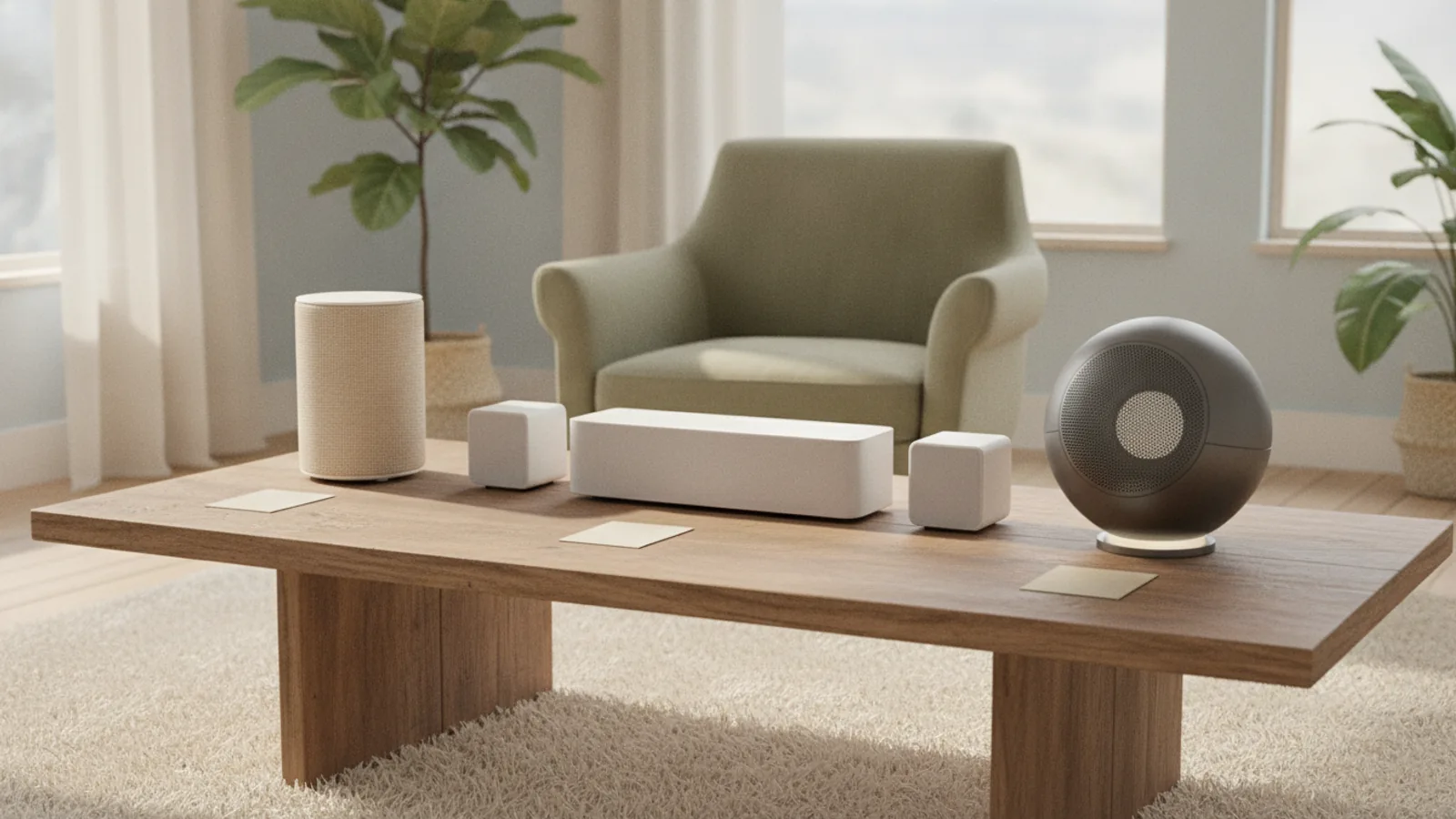
Learn the basic differences among single-driver speakers, two-way designs with a tweeter and woofer, and multi-driver arrays with separate bass radiators or omnidirectional dispersion. A single full-range driver often produces a coherent soundstage and a compact footprint, which can be ideal for a calm room, but it may struggle with deep bass. A two-way design typically offers clearer highs and more defined bass, though it may be larger and project sound more directionally. Consider how the speaker disperses sound in a room: some fire upward or in a 360-degree pattern to fill the space evenly, reducing the need to point them at the listening chair. Also look at the cabinet material and shape, as these influence resonances. This research narrows your list and helps you predict how each speaker will interact with your room's acoustics, so you are not comparing apples and oranges.
Evaluate Connectivity and Control Options for a Seamless Setup
Now look at how each speaker connects to your devices. Decide whether you need Bluetooth, Wi-Fi, a wired input, or a combination. Bluetooth is easy but may add a small amount of compression; Wi-Fi often supports higher-quality streaming and multi-room features, but it requires a stable network. If you use a turntable or a computer, a wired auxiliary or optical input may be essential. Consider the control interface: physical buttons, a remote, or an app. For a calm room, check whether the speaker has a night mode or bass reduction feature that does not require opening an app, and verify that any indicator lights can be dimmed or turned off. Also, think about multi-speaker setups if you might expand later. This step prevents post-purchase disappointment over connectivity that does not fit your habits.
Create a Consistent Testing Procedure at Home
Before comparing speakers, set up a controlled test in your own room. Pick three tracks: one with a solo voice so you can judge clarity, one acoustic instrumental so you can evaluate separation of instruments, and one with bass notes so you can assess low-frequency control. Play each track at a moderate volume (about 70 decibels) for at least two minutes. Use the same playback source and adjust the speaker's position identically each time. Place the speaker on a stable surface, away from wall corners if possible, and keep the listening position the same. Take notes on how the speaker sounds at low volume, at high volume, and during quiet passages. This procedure reveals differences that casual listening in a showroom would never show, and it tells you which speaker genuinely suits your room's acoustics.
Listen Critically for Tonal Balance and Room Interaction
During each track, focus on the frequency balance. Does the speaker sound warm and full, bright and detailed, or have a pronounced midrange? Notice whether vocals appear natural or slightly honky, and whether cymbals have a realistic shimmer or an exaggerated hiss. Check for bass clarity: are individual bass notes distinct, or do they blur into a boom? Also, listen for imaging and soundstage width: Can you point to the approximate location of each instrument across the space between the left and right speakers? Walk around the room to see how the sound changes as you move off-axis. Compare this to the calm feeling you want—if a speaker forces you to sit in one 'sweet spot' to sound good, it may be less relaxing in daily use. Trust your ears over any spec sheet.
Decide Based on Your Checklist and Perform a Final Home Trial
After testing all candidates, compare your notes against the criteria you defined in step one. Look for a speaker that passes your core tests: clear enough for your main content, bass that does not excite room resonances, and a design that blends calmly into your space. Before buying, spend an extended period—at least a full evening—with the speaker in the actual listening position and at various times of day. Play different genres and listen at background levels. Also, test the speaker's controls and any companion app in your home network to see if it remains calm and intuitive. Remember that the best speaker for you is not the most expensive or most hyped, but the one that consistently delivers the sound and serenity you seek. Once you are satisfied, make the purchase and set it up with peace of mind.
Quick Reference
| Situation | Action | Why it helps |
|---|---|---|
| You want a speaker for a small, acoustically live room with hard floors and bare walls. | Choose a speaker with a 'tone' or 'EQ' setting that can reduce treble, and place it on a soft rug or shelf with books to break up reflections. | Hard surfaces create harsh echoes that can make a speaker sound bright and tiring; adjusting its tone and adding absorption restores calm and clarity. |
| You will be listening at a fixed desk position for long periods and want a focused, accurate sound. | Select a two-way speaker with a front-firing tweeter and position the tweeters at ear level, toeing them in slightly toward your listening spot. | A directional tweeter gives a precise stereo image and minimizes the effect of room reflections, which helps you hear recording nuances without ambient muddiness. |
| You plan to place the speaker on a bookshelf or a cabinet, close to a wall, and dislike booming low frequencies. | Look for a speaker with a rear bass port that is designed for boundary placement, or use the speaker's 'bass reduction' or 'wall mode' setting, and keep it a few inches away from the wall. | A wall amplifies bass by creating a coupling effect, which can overwhelm the sound; reducing bass or increasing the gap tames that boom. |
Common Issues
- The speaker produces a muffled or indistinct sound when placed inside a closed shelving unit.: Move the speaker to an open shelf or the top of a cabinet, and ensure the front of the speaker is not blocked by cabinet frames; if you cannot move it, try angling the speaker upward slightly and place it at the front edge.
- Voice and lyrics are clear, but the speaker distorts at moderate volume, especially with dynamic tracks.: Lower the playback volume a notch and enable any 'loudness' or 'night' mode, but if distortion persists, check the speaker's driver for damage or consider a model with larger drivers or a separate subwoofer.
- The speaker's bass notes seem to disappear or become boomy depending on where the listener sits in the room.: Walk around the room to find spots where the bass sounds consistent, then move the speaker to a different wall or corner; if the problem remains, use the speaker's built-in EQ to reduce the low frequency, and consider adding a soft furnishing like a rug to absorb standing waves.
Advanced Tips
- For critical listening, experiment with the speaker's toe-in angle: even a 5-degree change can refine the treble and imaging, making long sessions less fatigue.
- If your speaker has a companion app, explore its EQ presets and save a custom curve that slightly reduces the 2-4 kHz range, which often carries harshness in many rooms.
- Consider using a high-quality, short and thick speaker cable if your speaker has wired inputs, as this can prevent subtle impedance issues that might affect transient response.
Final Checklist
- I have defined my primary listening scenarios and room dimensions before comparing models.
- I tested my top speaker candidates in my own room using my chosen tracks at a consistent volume.
- I verified that the speaker's connectivity, controls, and indicator lights are compatible with my devices and do not create visual noise.
- I have placed the speaker in its final spot, tweaked the tone or position as needed, and confirmed that it delivers both sound quality and a calm atmosphere.
FAQ
How important is the speaker's frequency response specification when comparing?
Frequency response gives a rough idea of a speaker's tonal range, but it does not tell you how it will sound in your room. The same speaker can sound different against a wall versus in the open. Instead of relying solely on numbers, listen for a balanced, non-fatiguing tone and make sure the bass is not overpowering or weak in your actual space.
Should I choose a single large speaker or two smaller ones?
If you want a calm room and simple setup, a single high-quality speaker can provide a spacious soundstage and less clutter. However, two speakers can give a more precise stereo image and a wider sound field, but they require more placement care. For most homes, a single well-chosen speaker placed in a central area can offer equally satisfying sound without taking over the room.
How can I test the bass response without turning the room into a boomy mess?
Play a track with a repeating bass line and walk slowly around the room to find where the bass swells and where it stays consistent. Move the speaker away from walls and corners to reduce boom. Use the speaker's bass and treble controls to find a balanced setting, and add a soft furnishing like a rug or a curtain if needed.